What People Are Actually Building in 2026
Skip the startup headlines. Here is what real people build with AI in 2026, from a bar inventory system to a trip diary for a nine-year-old, and where it lands.
In this post
- What are people actually building with AI?
- Internal tools: the quiet majority
- Personal software: apps for an audience of one
- Software for small businesses
- Agents and automations
- Games, pages and decks
- What do these projects have in common?
- Where do these projects end up?
- How to give what you built a home
- Key takeaways
The headlines are about AI startups raising money. The real story is quieter, and it lives in comment threads, where people post something they made for their team, their shop, or their kid.
This is a look at what people are actually building with AI in 2026, drawn from public posts, community threads and the surveys that try to count it. Most of it is small. Almost all of it is useful. And a surprising amount of it never leaves the screen it was made on.
What are people actually building with AI?
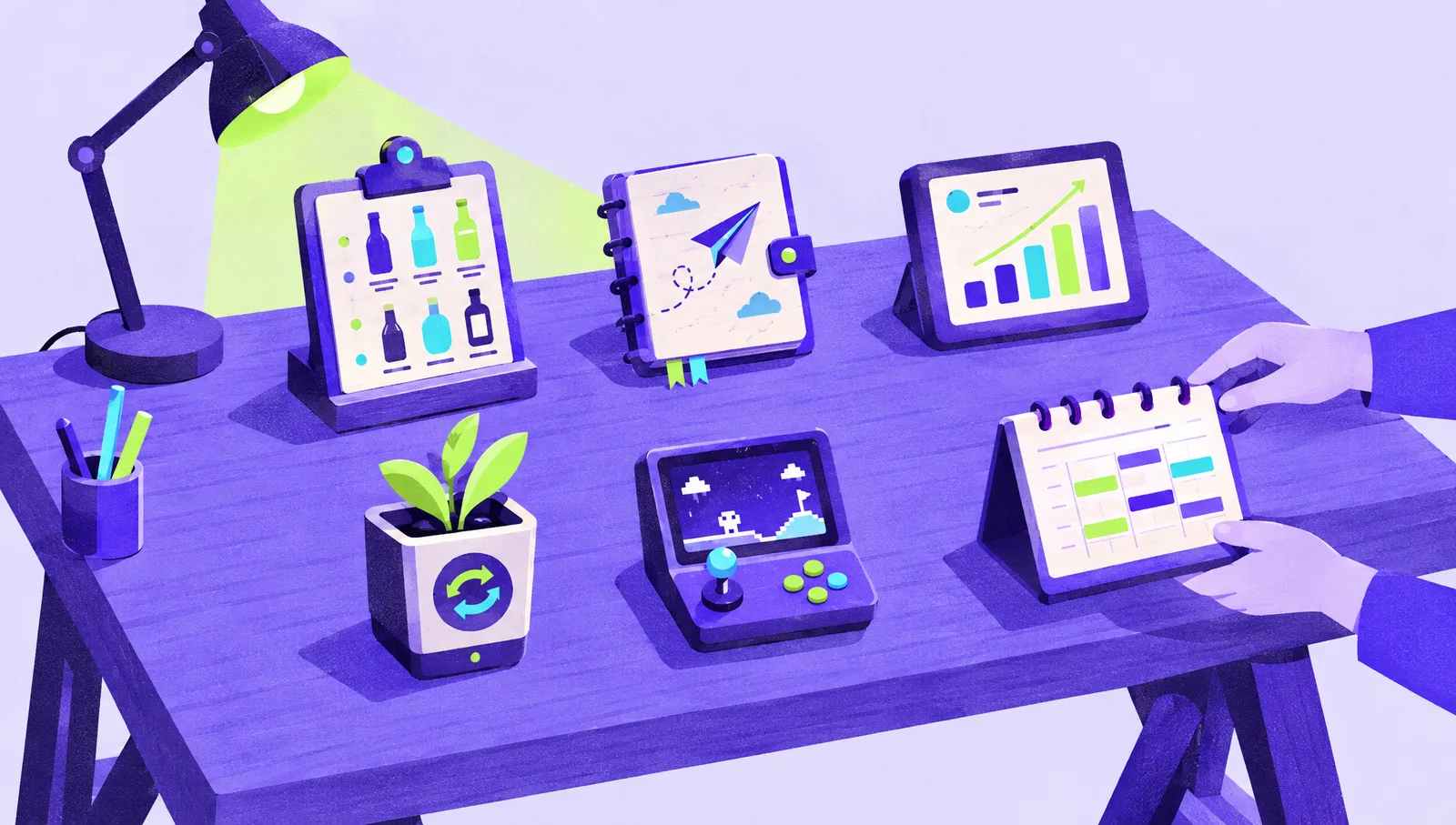
In short: small, specific software for a known audience. Internal tools for a team, personal apps for an audience of one, and replacements for software a small business used to rent. Games, pages and simple agents fill out the rest.
The scale is real. Lovable reported one million new projects a week in June 2026, and says that 80% of its builders describe themselves as non-technical. Those are company figures, but they match what you see everywhere else. A Zapier survey of about 800 US workers who built a work tool with AI found a third had no formal programming background.
One honest counterweight before the examples. a16z’s Justine Moore estimates that people who vibe code are still maybe 1% of the population, mostly people who were already a little technical. The wave is real. It is also early.
Internal tools: the quiet majority
If you had to pick one category, it would be this one.
In Retool’s 2026 build-vs-buy report, a survey of 817 builders, 35% said they had already replaced at least one SaaS product with something they built. The most replaced categories were workflow automations, internal admin tools, BI dashboards, CRMs and form builders. When people built outside their IT team’s view, the top three things they made were internal tools, workflows and dashboards. Retool sells into this market, so read the numbers as a signal, not a census. The direction is clear.
Zapier’s survey tells the same story from another angle. The most common things people built were data analysis and visualization tools, forms and data collection, and chatbots or assistants.
What these look like in practice:
- Review tools for one team. Anthropic’s legal team built a self-check that lets marketing run copy past a legal checklist in Slack before it reaches a lawyer, which they say cut review time from two or three days to about a day. The lawyer behind several of these tools does not write code. (This is Anthropic writing about its own staff, so it is a best case.)
- A CRM shaped exactly like the business. On Hacker News, one builder argued that the main real use of AI-built software is internal tooling that replaces a SaaS contract and weeks of integration work.
- Dashboards that answer one question. How is the quarter going. Which orders are late. Who has not finished onboarding.
None of these will ever have a launch day. They are built for twelve people and they matter to those twelve every morning.
Personal software: apps for an audience of one
The second category is software for a market of one person, or one family.
Jeroen, a 49-year-old manager in the Dutch government with two kids, posted on Hacker News that until the previous December he had never written a line of code. His nine-year-old was going to Japan, and he wanted her to have a trip diary she could share with family. He learned with ChatGPT, then built the app with Claude Code and the Claude agent in Xcode. It is now a free iPhone app called TravElly, where parents load the itinerary and kids add photos and diary entries.
Francis Irving, who is face blind, built a small set of personal apps in 2026: one for restaurant lists, one for music, and one for learning people’s names and faces with spaced repetition. The write-up calls the results “frankly amazing” and, in the same breath, a bit too vibe coded. One reorder bug deleted a whole list before the agent helped recover it.
Threads like “What have you built with Claude Code?” are full of the same shape: phonics flashcards for someone’s kids, a price tracker, a form builder clone for a single use. An accountant on another thread built a plant and cuttings swap app because the app they wanted did not exist.
Even the platforms have noticed. In October 2026 Google Play started supporting private apps built in AI Studio, visible only to the person who made them.
Software for small businesses
Small businesses rent a lot of software they only half use. AI makes it reasonable to build the half they need.
- A bar’s inventory system. The owner of a small bar wrote on Hacker News that they built their inventory system with Claude Code, and that the AI credits still cost less than the paid product they would otherwise use.
- Commerce command centres. Bolt collected stories from owners who replaced stacks of subscriptions with one tool built for their shop. These are marketing stories from the vendor, but the pattern is consistent with the surveys above.
- Volunteer and shift planning. When Wix bought Base44, its founder described users building tools to manage volunteer shifts, alongside games and apps for people with PTSD.
The common thread is replacement. Not “I built a startup”, but “I stopped paying for something that never quite fit.”
Agents and automations
Agents get the most attention and, so far, the least actual building by non-developers. A former Replit product leader told Sacra that people on the platform mostly build apps and websites, not agents.
What does get built is the humble version: a job that runs every morning, pulls some numbers and sends a summary. A watcher that checks a page and posts when it changes. A triage step that sorts incoming requests before a human sees them. In Retool’s survey, automated workflows were the single most replaced SaaS category.
The ambitious end exists too. OpenClaw, a self-hosted personal agent, became one of the fastest-growing projects on GitHub. That story, and the trouble people had installing it, is a post of its own: Everyone’s Publishing Open Source. Almost Nobody Can Run It.
Games, pages and decks
The creative side is the most fun to watch. The 2025 Vibe Jam, judged by Andrej Karpathy and Pieter Levels, drew more than 1,000 game submissions, and the 2026 edition requires that at least 90% of the code is written by AI. Levels’ own browser flight simulator, built quickly with AI, became a talking point for how much attention a small game can get.
Then there is the long tail: a landing page for a bake sale, a pitch deck as a web page, a birthday quiz. Hostinger, whose AI builder was tried by more than a million people in its first year, reported that about half of all prompts asked for business, marketing or portfolio sites.
What do these projects have in common?
Look across the categories and the same traits repeat:
- Small. One screen, one job, a handful of users.
- Specific. Built for a named audience: this team, this shop, this kid.
- Real data. Orders, stock, schedules, scores. Things that should still be there tomorrow.
- Fast to make. In the Zapier survey, 30% of builders went from idea to working tool in under a day.
- One owner. The person who built it is also the person who keeps it alive.
That last trait is where the trouble starts.
Where do these projects end up?
This is the part the success stories skip. In the same Zapier survey, 92% of builders said they had hit a major challenge, most often bugs and security or privacy concerns. TechCrunch pointed out that Lovable does not report how many of its million weekly projects are abandoned, and that the hard part of software is maintaining it.
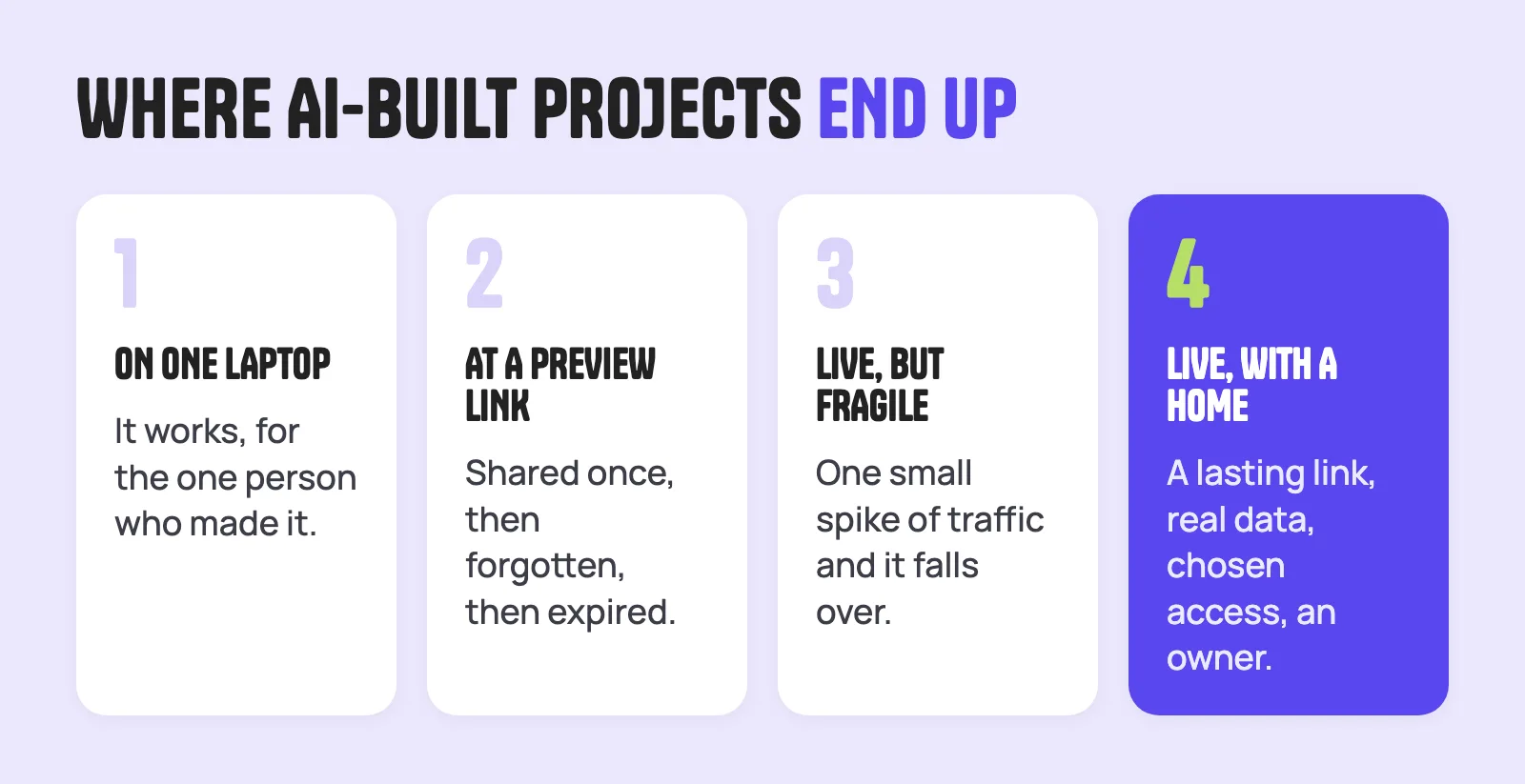
A lot of AI-built work ends in one of three places:
- On one laptop. It works, but only for the person who made it.
- At a preview link. Shared once, then forgotten, then expired.
- Live, but fragile. On Hacker News, one builder’s app went down on a free hosting tier when a little traffic arrived, which they called “too much success.”
The making got easy. Giving it a home did not. We wrote about that gap in The Last Mile of Software, and about what happens to teams when everyone builds in The Cloud Wasn’t Built for This.
How to give what you built a home
If you have made something like the projects above, CloudGrid is built for exactly that next step. You plug it in from the tool you made it with, and it goes live with what it needs, whether that is a database, storage, AI models or a schedule.
Pick the guide that matches what you made:
- An app or internal tool: make an app live
- Something that runs on its own: make an agent and build an agent that runs on a schedule
- A game: make a game live
- A page or a deck: make a page or a deck
- Made it in a chat tool? Start from Claude or ChatGPT
Or browse all the builder guides.
Key takeaways
- Most AI-built software is small and specific: internal tools, personal apps and small-business tools, built for a known group of people.
- Internal tools lead. Surveys consistently put dashboards, forms, workflows and admin tools at the top.
- Replacement is the motive. People build the part of a rented tool they actually need.
- Agents are rarer than the hype suggests, and mostly take the form of simple scheduled jobs.
- The weak point is after the build: hosting, data, security and upkeep decide whether a project lasts.